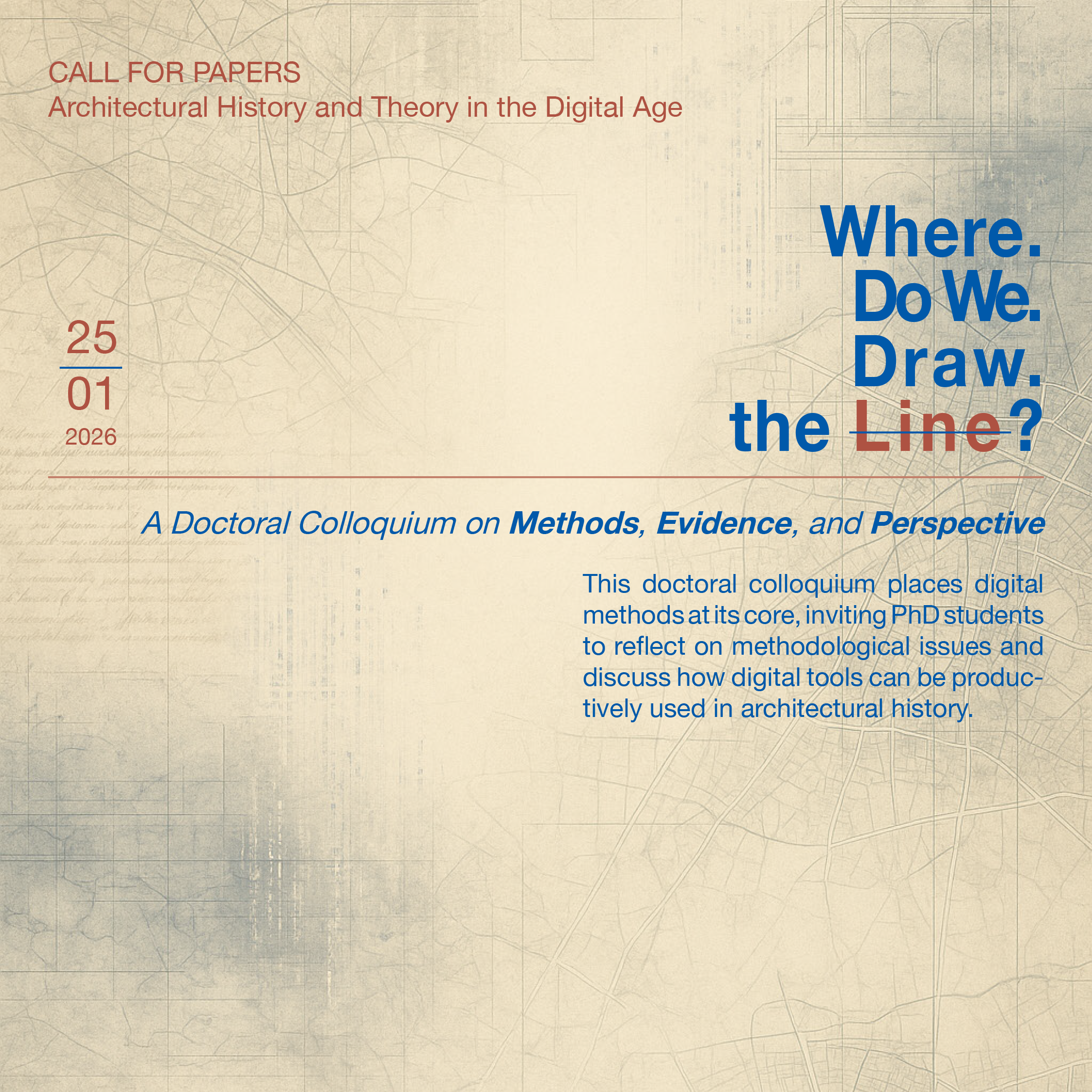
Where Do We Draw the Line? Architectural History and Theory in the Digital Age – SAHANZ PhD Colloquium 2025

A Doctoral Colloquium on Methods, Evidence, and Perspective, hosted by the Research and Design Centre of Urban Liveability in School of Design, Shanghai Jiao Tong University
Colloquium Theme:
Digital tools have not been widely adopted in architectural history because they have long sat uneasily with a discipline centered on social and cultural concerns. In recent years, however, digital methods for processing and mining archives have been taken up by a growing number of scholars. At the same time, the supposed universality of digital technology is often treated as a cross-cultural instrument that can reduce misunderstanding and close distance, yet this claim still needs careful testing. Digital tools also open new possibilities: unprecedented access to information can make researchers feel “all-knowing,” raising the question of whether this enables us to rebuild discourse and construct knowledge from noncentral perspectives.
Against this backdrop, this doctoral colloquium places digital methods at its core. It invites doctoral students to share methodological reflections and discuss how these tools can be used productively and what they mean for architectural-historical research. We hope to prompt every doctoral student in architectural history to reflect on their own position and perspective.
We invite contributions that critically probe this turning point. Possible angles include:
- Maps that “tell” history: GIS, spatial statistics, and the cartographic imagination.
- Digital modelling and urban re-enactment: 3-D reconstructions, speculative simulations, and their historiographic claims.
- Ethics of method: do new technologies illuminate or erode notions of historical truth?
- Archives after the digital turn: reading maps, photographs, and permits as data; confronting copyright and curation dilemmas.
- From text to data: are we rewriting architectural history when we translate narrative sources into structured datasets?
- Writing otherwise: how do visualisations, dashboards, or interactive platforms extend or unsettle conventional scholarly prose?
These angles are not exhaustive, and we also welcome broader methodological reflections. By sharing work-in-progress, doctoral researchers will chart the opportunities and limits of digital methods, clarify their epistemological implications, and sketch future paths for a critically informed, technically agile architectural historiography.
Sessions:
Sessions will be organised around the accepted abstracts, ideally grouped into 3-4 panels, each with its own chair and respondent. The provisional panel topics are as follows:
1. Digital Workflows, Technical Standards & Methodological Innovation
2. Data, Evidence & Historiographical Claims.
3. Method as Boundary: Where do we stand?
*All sessions of the colloquium will be conducted in English.
Submission Guidelines
Abstract length: up to 300 words (in English)
*All presenters must be members of SAHANZ. Information on membership and how to join can be found here: https://www.sahanz.net/about/membership/
Event Time
China (CST): 25 January 2026, 09:00–16:00 (NOTE: This is local time in Beijing)
Australia (AEDT, East Coast): 25 January 2026, 12:00–19:00
New Zealand (NZDT): 25 January 2026, 14:00–21:00
*The colloquium will be held online.
KeyDates
Abstract Deadline: 20 October, 2025
Acceptance Notification: 10 November, 2025
Participation Registration form: 30 November, 2025
Colloquium Dates: 25 January, 2026
Ph.D. Colloquium Committee
Chair: Huichao Luo (Shanghai Jiao Tong University)
Members: Yue Zhu (Xi’an Jiaotong Liverpool University), Chaoxin Yan (Shanghai Jiao Tong University), Yanhan Chen (Shanghai Jiao Tong University)
Academic Advisor
Xing Ruan (Shanghai Jiao Tong University)
Hao Wang (Shanghai Jiao Tong University)
Academic Support
SAHANZ
Research and Design Centre of Urban Liveability in School of Design, Shanghai Jiao Tong University